

“Each handcrafted piece celebrates goddesses, feminine deities, spirits, and folklore figures”: How Oshun’s Vanity honours ancestral legacies from across the African diaspora
Right down to the name, Oshun’s Vanity is rooted in spirituality and self-adornment. Teaching herself to wire jewellery, founder Sharifah Grant turned a Pinterest pastime into a flourishing business, paying tribute to folklore from the African diaspora with her handcrafted accessories.
What is Oshun’s Vanity, and what’s the vision behind it?
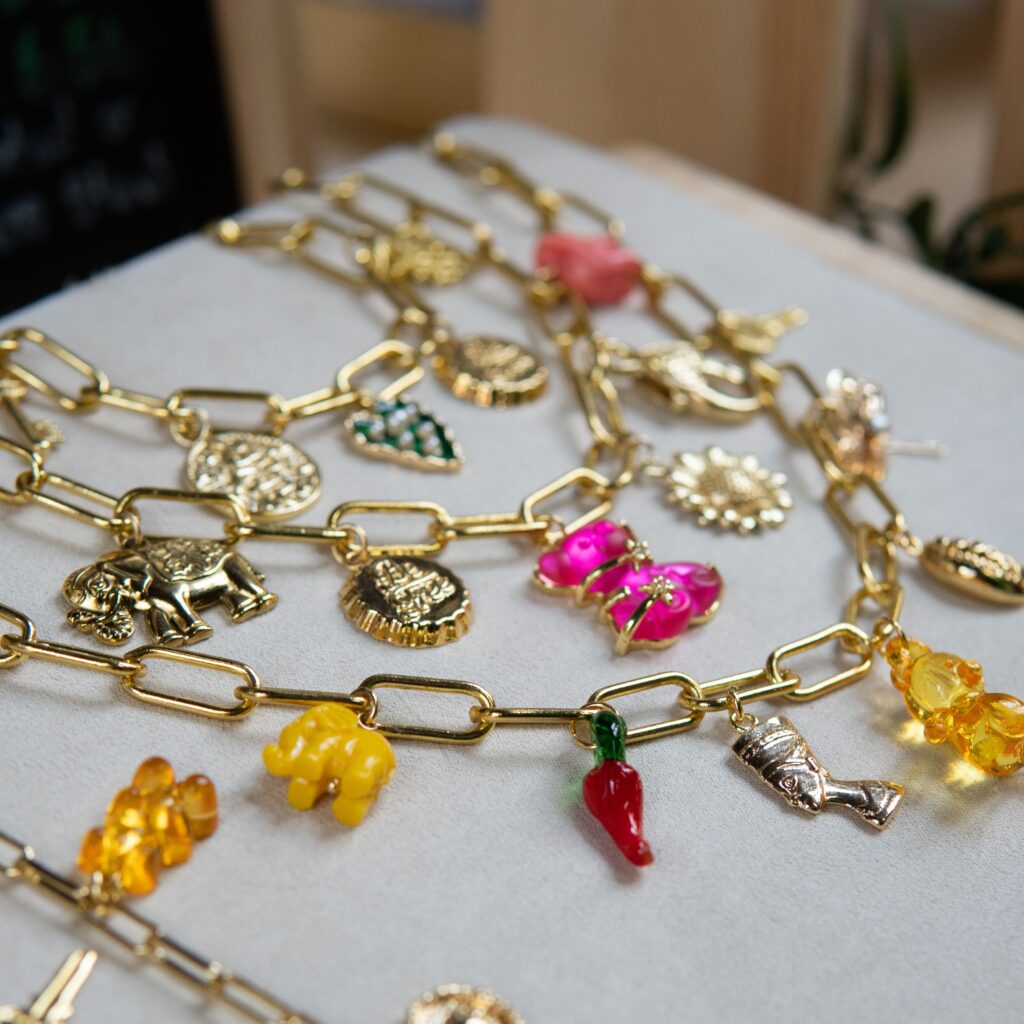
Oshun’s Vanity is a soulful, London-based jewellery brand drawing inspiration from Mother Earth and Indigenous spiritual traditions. Each handcrafted piece celebrates goddesses, feminine deities, spirits, and folklore figures from Africa, the Americas, and the Caribbean, blending ancestral stories into wearable art.
Through Oshun’s Vanity, I create with intention, offering luxuries that connect mind, body, and spirit to the divine. Historically, Black women have never worn jewellery as “just” decoration. Our adornments have served as a system of meaning – spiritual protection, social communication, and political defiance. Oshun’s Vanity wishes to mirror this perception of adornment – as language.
It’s a language of beauty, myth, spirit, and history, serving as a marker of identity. By naming pieces after powerful deities and feminine figures, Oshun’s Vanity invites you to join me in discovering their stories. I hope this creates space for women to deepen their connection to their own divine feminine.
What’s the meaning behind the name Oshun?
Oshun’s Vanity is named after Oshun, the riverine Orisha of the Yoruba people, whose worship is rooted in the ancient town of Oshogbo, Nigeria. As a deity of love, prosperity, beauty, dance, and fertility, she holds a central place in Yoruba cosmology.
Oshun’s presence reaches far beyond Nigeria. She is venerated across West Africa and reappears throughout the African diaspora: as Oxum in Brazil and other parts of South America, Ochún in Cuba and Puerto Rico, Erzulie in Haiti, within Trinidad Orisha/Shango Baptist, and in Louisiana Voodoo.

Why did Oshun resonate with you?
Oshun is known for her alluring beauty. She appears with dark, velvety skin; a bright, feathered headdress; and luminous yellow silk draped around her body. She wears five golden brass bracelets and holds a golden mirror, admiring her mirror image. Gold and brass jewellery define her image, symbolising wealth, sensuality, and spiritual power, and serve as healing for those who honour her. Like her river, she remains ever in motion, following her destined course.
I didn’t just name my brand after Oshun; it felt like she chose me. Even before learning her story, I was drawn to colours and symbols that echoed her. Oshun’s energy mirrored my growing awareness of the divine feminine in myself. She doesn’t hide her beauty – she owns and honours it. In her presence, beauty transcends vanity, becoming devotion, power, and spiritual expression.
Oshun’s Vanity helps you do the same, transforming jewellery into talismans of myth, escapism, and self-adornment.
How did you learn to craft your own pieces?
I became a jeweller by accident, and over time I found myself falling in love with the craft. During lockdown, I spent hours on Pinterest, drawn to vintage images of Black women wearing beautiful jewellery.
I became fascinated by nose rings worn by Nubian, Amazigh, Oromo, Sudanese, and Nilotic women. That interest rapidly grew into an obsession with eccentric nose jewellery. However, the pieces that drew me in were simply out of my price range. I’m the kind of person who, if I can’t afford something and am feeling impatient, will find a way to make it myself.

What piece did you start with?
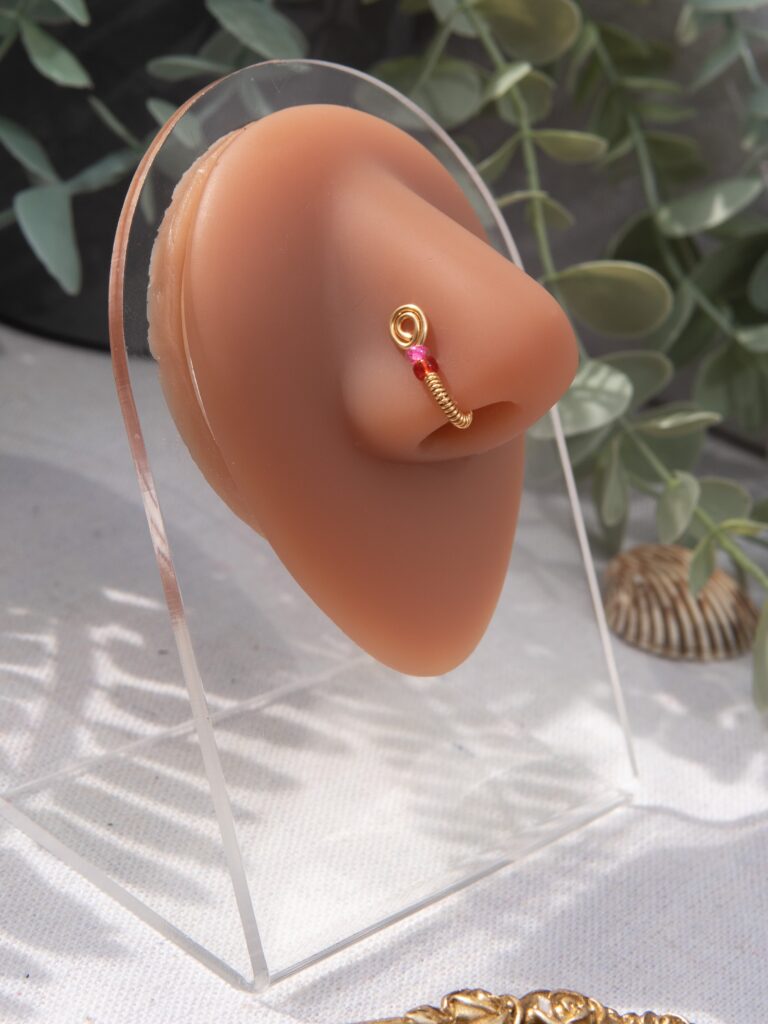
Wanting to explore unconventional nose ring designs without being limited by practicality, I decided to create a nose cuff instead – a piece of jewellery that rests on the outside of the nose, gives the appearance of a piercing, and doesn’t require one. My background in textile technology naturally drew me to wirework: the same principles of structure, tension, and movement on the body now guide how I sculpt wire into delicate, elaborate wearable jewellery.
At this time when I was struggling with sleep and my mental health, I found myself handling wire almost like a fidget toy, and over time I realised I couldn’t put it down. In that process, I taught myself through experimentation and trial and error.
Nose cuffs allowed me to enjoy that aesthetic and honour those references without damaging my skin, as I have keloid skin. That’s where it all began: what started with nose cuffs has since grown into a broader practice, expanding into earrings, necklaces, bracelets, and other jewellery.
Once you had the craft down, what were the steps you took to turn it into a business?
I never planned to turn my craft into a business. As Oshun’s Vanity started to take shape, I regularly found myself thinking, “Am I really doing this? What the hell?”
During lockdown, my mum taught herself to make face masks using the most beautiful array of Ankara fabrics. They drew a lot of interest, and friends began requesting them, so I opened an Etsy shop and started selling. Because I was furloughed, I had plenty of time; it felt casual at first, but the shop quickly gained traction.
Meanwhile, jewellery making was my personal de‑stressor. When masks were no longer needed, I had to decide whether to close the shop or change direction. I chose to pivot from masks to jewellery, which allowed me to draw on my Creative Direction for Fashion degree and really lean into branding and visual identity.
From there, Etsy evolved from a fun side project into a meaningful creative outlet, even after I returned to work. By 2023, steady growth, creative fulfilment, and rising demand convinced me to commit to Oshun’s Vanity full‑time and treat it as a business. Along the way, I self‑learnt photography to showcase my pieces, and before this venture, I had already taught myself video editing, which I used to create content for social media and the web. In 2024, I took the brand offline as well, bringing my business in person through market trading.

What are some of your bestselling items?
Some of my bestselling pieces include the Modjadji Nose Cuff: inspired by Makobo Modjadji, the youngest Rain Queen of the Balobedu in South Africa, this piece honours feminine power, leadership, and the life-giving forces of rain and rivers.
The Atabey Nose Cuff is inspired by Atabey, the Taíno mother goddess of the moon, fresh water, and fertility. She embodies nurturer, lover, and storm-bringer.
La Sirene Collection is also popular; this is a series of pieces inspired by La Sirène, the Haitian Vodou spirit of the sea, beauty, music, dreams, and wealth. She’s the alluring mermaid lwa who rules hidden treasures and the mysteries beneath the waves.
Why is it important to you to represent elements of global Black culture in your pieces?
A short time before learning the craft of jewellery-making, I came across Jambalaya by Luisah Teish, a spiritual classic that combines memoir, folklore, and hands-on rituals. It opened a doorway for me into African-based spirituality and my own growth. There was a recognition that, amidst the chaos, the one thing that brought me mental peace was my introduction to indigenous spiritual systems and feminine divine entities that embodied natural forces and human qualities.
Through their stories, these entities were showing me how to navigate life – love, conflict, power, jealousy, courage, creativity, grief. They aren’t distant abstractions; they have personalities, flaws, and wisdom that mirror our own struggles. Through their stories, I can strengthen my relationship with my ancestors and feel I’m mirroring their spiritual connection to nature, without limiting my understanding of them to the transatlantic slave trade and everything that followed.
By weaving their symbols, colours, and stories into my pieces, I can show how these figures are deeply connected: they reappear under different names and in different regions, yet carry similar energies, lessons, and lineages. Representing elements of global Black culture in this way allows me to highlight that we are not separate or scattered; we are in conversation with one another across time, water, and geography. My work becomes a way to map those spiritual continuities and to remind us that our traditions travel, transform, and still belong to us.

What does the brand mean to you as your own creative outlet?
As a neurodivergent creative, I’ve always experienced intense hyperfixations, and jewellery making was one of them. I knew I didn’t want it to stay a passing obsession; it needed to carry real, lasting meaning. Rooting my craft in spiritual belief systems and their entities gave me both personal alignment and a foundation for my brand.
Oshun’s Vanity allows me to translate spiritual knowledge into a visual, tactile language. Because my neurodivergent traits can make it harder for me to retain information, I turn to jewellery – my form of wearable art – as a way to transform each piece into a tangible anchor for these teachings.
In this way, the brand is not just a creative outlet; it’s a living, sensory archive of my learning and devotion to share. Every piece becomes a wearable reminder of the deities, teachings, and stories that guide my path.
“Representing elements of global Black culture in this way allows me to highlight that we are not separate or scattered; we are in conversation with one another”
What has the reception from customers been like so far?
The reception has been really warm and full of intrigued curiosity. When people visit my market stall, they often say it feels like they’re being told a visual story. Some customers are reminded of things from their childhood, or drawn to the names of the pieces. The names often spark questions – what these names stand for, my origins or how a particular deity connects to their own culture. It’s created a really beautiful space for conversation, where I get to learn more about how these divine entities reappear in our lives and the impact spirituality continues to have across the diaspora.

What’s been your proudest moment running Oshun’s Vanity?
Overcoming some really daunting challenges on my own has definitely been one of my proudest experiences running Oshun’s Vanity. It’s forced me to acknowledge the skills I already had, as well as the ones I’ve had to teach myself along the way.
One standout moment was creating my own website. At the time, Etsy was undergoing infrastructure changes, and my shop was suspended. What seemed like a mistake on their side turned into an incredibly frustrating situation, because I was never able to reach their customer service and retrieve my account.
That experience was a hard reality check about business. Etsy had been the anchor of my work and when it was gone, I learned that losing everything and starting again is part of the journey, not the end of it.
My website became a symbol of ownership and independence. I had to push myself out of my comfort zone, especially with writing copy, and confront my complicated relationship with words. But doing that made the brand feel even more authentic.
–
Jamii members get 15% off Oshun’s Vanity – find out more